Download An Image Of The Kopacz Coat Of Arms UPDATED
Download An Image Of The Kopacz Coat Of Arms
| Glaze of arms of Poland | |
|---|---|
 | |
| Armiger | Republic of Poland |
| Adopted | 26 June 1295; last modified in 22 February 1990 |
| Blazon | Gules, an eagle argent, armed, crowned and beaked or, langued argent |
The glaze of arms of Poland is a white, crowned hawkeye with a aureate pecker and talons, on a red background.
In Poland, the glaze of arms as a whole is referred to every bit godło both in official documents and colloquial speech communication,[1] despite the fact that other coats of arms are usually called an herb (eastward.g. the Nałęcz herb or the coat of artillery of Finland). This stems from the fact that in Polish heraldry, the word godło (plural: godła) means just a heraldic charge (in this particular case a white crowned eagle) and not an entire coat of arms, but information technology is also an archaic give-and-take for a national symbol of whatsoever sort.[2] In after legislation only the herb retained this designation; it is unknown why.
Legal basis [edit]
The coat of artillery of the Republic of Poland is described in 2 legal documents: the Constitution of the Democracy of Poland of 1997[three] and the Coat of Arms, Colors and Anthem of the Commonwealth of Poland, and State Seals Human action (Ustawa o godle, barwach i hymnie Rzeczypospolitej Polskiej oraz o pieczęciach państwowych) of 1980 with subsequent amendments[1] (henceforth referred to equally "the Coat of Arms Act").
Legislation concerning the national symbols is far from perfect. The Glaze of Arms Human action has been amended several times and refers extensively to executive ordinances, some of which have never been issued. Moreover, the Deed contains errors, omissions and inconsistencies which make the law confusing, open to diverse interpretations and often not followed in practice.[iv]
Design [edit]

According to Affiliate I, Article 28, paragraph 1 of the Constitution, the coat of arms of Poland is an image of a crowned white eagle in a red field.[3] The Coat of Arms Act, Article four, further specifies that the crown, likewise as the eagle'due south beak and talons, are gold. The eagle's wings are outstretched and its head is turned to its right.[i] In English heraldic terminology, the arms are blazoned as Gules an eagle crowned, beaked and armed Or.[ citation needed ] In contrast to classic heraldry, where the aforementioned blazon may exist rendered into varying designs, the Coat of Artillery Human action allows only one official rendering of the national glaze of arms. The official design may exist found in attachment no. 1 to the Glaze of Arms Act.[1]
The almost circular charge, i.e., the prototype of the white eagle, is highly stylized. The heraldic bird is depicted with its wings and legs outstretched, its head turned to the right, in a pose known in heraldry equally 'displayed'. The eagle's feather, besides as its natural language and leg scales are white with slope shading suggestive of a bas-relief. Each fly is adorned with a curved band extending from the bird'due south torso to the upper edge of the wing, terminating in a heraldic cinquefoil. Note that a cinquefoil is a stylized five-leafed plant, not a star. Three of its leaves are embossed like a trefoil (note similar trefoils in the medieval designs of the eagle). In heraldic terms, the eagle is "armed", that is to say, its beak and talons are rendered in gold, in contrast to the body. The crown on the hawkeye'south head consists of a base and three fleurons extending from it. The base is adorned with three roughly rectangular gemstones. The fleurons – of which the two outer ones are but partly visible – have the shape of a fleur-de-lis. The entire crown, including the gems, as well as spaces between the fleurons, is rendered in aureate.
The charge is placed in an escutcheon (shield) of the Modern French type. It is a nearly rectangular upright isosceles trapezoid, rounded at the bottom, whose upper base is slightly longer than the lower ane, from the middle of which extends downward a pointed tip. Although the shield is an integral office of the glaze of artillery, Polish law stipulates, in certain cases, to just utilise the charge without the escutcheon. The shades of the master tinctures, white (Argent) and red (Gules), which are the national colors of Poland, are specified as coordinates in the CIE 1976 colour space (encounter Flag of Poland – National colors for details).
History [edit]
According to legend, the White Hawkeye emblem originated when Poland'southward legendary founder Lech saw a white hawkeye's nest.[v] When he looked at the bird, a ray of sunshine from the blood-red setting sun barbarous on its wings, so they appeared tipped with gold, the rest of the eagle was pure white. He was delighted and decided to settle at that place and placed the eagle on his emblem. He likewise named the place Gniezdno (currently Gniezno) from the Polish discussion gniazdo ("nest").

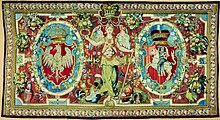
The symbol of an eagle appeared for the first time on the coins made during the reign of Bolesław I (992-1025), initially as the coat of arms of the Piast dynasty. Commencement in the 12th century, the eagle has appeared on the shields, ensigns, coins, and seals of the Piast dukes. It appeared on the Polish coat of arms during Przemysł 2 reign as a reminder of the Piast tradition before the fragmentation of Poland.
The hawkeye'southward graphic course has inverse throughout centuries. Its recent shape, accepted in 1927, was designed past professor Zygmunt Kamiński[6] and was based on the hawkeye'south form from the times of Stefan Batory'southward reign. It was adapted to stamps or circular shields rather than to a rectangular shape.

The arms of the Polish–Lithuanian Commonwealth was quartered, with Polish eagle and Lithuanian Pahonia on opposite sides. Kings used to place their own emblems in the center of the national coat of arms (i.e., House Vasa).
Despite the fact that new emblems were given to provinces established past the invaders afterward the partitions of Poland, the White Eagle remained there with or without crown and occasionally with face turned towards left and in some exceptions with Pahonia. Simply in most cases they were combined with the invader's emblem.
The Poles conscientiously nerveless coins from the pre-partitions period with the eagle on their obverse and opposite. The symbol of the eagle, often with Pahonia, appeared on numerous flags and emblems of the Nov Uprising.


Coat of arms of Poland in Paris during the exposition in 1937
The resurrection of the Polish Kingdom (Polish Regency) in the territories of the former Congress Poland (which had been partitioned and annexed past the Russian Empire as the Vistula State in 1867) was approved past Austria-hungary and Wilhelm II'due south Germany in 1916. A yr later, the outset Smoothen banknotes (Polish Marka) with Crowned Eagle on an indivisible shield were introduced. After regaining total independence and the creation of the 2nd Polish Republic (1918–1939) the White Hawkeye was implemented past the act of 1919. Official epitome of the coat of arms (which resembled the keepsake of Stanislaus Augustus) was used until 1927 when Zygmunt Kamiński designed a new one. According to the research of Polish heraldist Jerzy Michta published in 2017, the version designed by Kamiński was really plagiarized from a 1924 medal past Elisa Beetz-Charpentier made in honor of Ignacy Paderewski.[7]
After World War Ii, the communist authorities of the Polish People'southward Democracy removed the "reactionary" royal crown from the eagle's head. Withal, Poland was i of the few countries in the Eastern Bloc with no communist symbols (scarlet stars, ears of wheat, hammers, etc.) on either its flag or its glaze of arms. The crownless design was approved by resolution in 1955. To counter that, the Polish government in Exile introduced a new emblem with a cross added atop the crown. After the fall of communism in 1989, the crown came back, but without the cantankerous.
The eagle appears on many public administration buildings, information technology is nowadays in schools and courts. Furthermore, it is placed on the obverse of Smoothen coins. However the outcome on which weather information technology should be exposed and how it should be interpreted is the topic of numerous debates in Poland. The eagle was formerly on the Poland national football squad'due south shirts; a new shirt without the eagle was introduced in November 2011, prompting complaints from fans and president Bronisław Komorowski. Due to this overwhelming public pressure, the football game shirts were redesigned with the eagle reinstated in the centre of the shirt in December 2011.[8]
Evolution [edit]
See also: Coats of arms of Kings of Poland, Flags_of_the_Polish-Lithuanian_Commonwealth
| Menstruum | Dates used | Glaze of arms | Achievement | Banner of artillery | Description and blazon |
|---|---|---|---|---|---|
| Duchy of Poland | 966–1025 |  | |  | Emblem of Civitas Schinesghe (1000 AD) from Coins of Boleslaus I of Poland. |
| Kingdom of Poland | 1295–1371 |  |  |  | Coat of arms of Piast dynasty. |
| Union of Hungary and Poland | 1370–1382 |  |  | | Coat of arms used under Louis I of Republic of hungary. party per cross, quarterly 1st, barry of eight Gules and argent and azure semé-de-lis or with characterization gule; 2nd, Gules, an eagle argent, crowned or; third, impaling Gules on a Mount Vert a Crown Or issuant therefrom a double-Cross Silver; 4th, azure three Lions' Heads affronté Crowned Or |
| Kingdom of Poland | 1217–1371 |  |  |  | The Kingdom of Poland and the Grand Duchy of Republic of lithuania joined in a personal union established by the Marriage of Krewo (1385). Quarterly 1st and 4th Gules, an eagle argent, crowned or; 2nd and 3rd, Gules, Pahonia. |
| Polish–Lithuanian Commonwealth | 1573–1575 |  | | | In the times of the Polish-Lithuanian Democracy inverse only orders and Inescutcheon, was placed in that location the personal glaze of artillery of the male monarch. Three fleurs-de-lis belonged to Henry III of France |
| Polish–Lithuanian Commonwealth | 1587-1668 |  |  |  | Business firm of Vasa (Wazy). |
| Polish–Lithuanian Republic | 1669-1673 |  |  |  | Michał Korybut Wiśniowiecki |
| Polish–Lithuanian Commonwealth | 1674-1696 |  |  |  | John 3 Sobieski |
| Polish–Lithuanian Commonwealth | 1697-1704 1709-1763 |  |  |  | Business firm of Wettin |
| Polish–Lithuanian Democracy | 1704-1709 |  |  |  | Stanisław Leszczyński |
| Polish–Lithuanian Commonwealth | 1764-1795 |  |  |  | Stanisław August Poniatowski |
| Duchy of Warsaw | 1807–1815 |  | 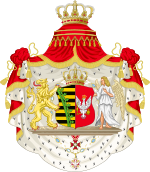 | | Coat of artillery of House of Wettin and smoothen hawkeye. |
| Kingdom of Poland | 1815-1832 |  |  |  | Glaze of arms of Congress Poland |
| Grand Duchy of Posen | 1815–1848 |  |  | Prussian eagle inescutcheon with polish hawkeye. | |
| Polish National Government | 1830–1831 |  | |  | Smoothen hawkeye and Pahonia |
| Shine independence movement | 1846 |  | | | |
| Polish National Government | 1863–1865 |  | | Archangel Michael represents Ruthenia | |
| Vistula Country | 1867–1915 |  | | ||
| Authorities General of Warsaw | 1915–1918 |  | | Seal of the Government-General of Warsaw, includes a Prussian eagle. | |
| Kingdom of Poland | 1916-1918 |  | | Hawkeye with the seal of the Regency Council | |
| 2nd Smoothen Republic | 1919-1927 | 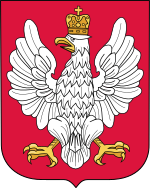 | |  | Offset modern coat of artillery of Poland. |
| Second Smoothen Republic and Polish Government in exile | 1927-1939 1939-1956 |  | | 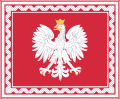 | Zygmunt Kamiński`s electric current project |
| Polish Regime in exile | 1956–1990 |  | |  | Added a cross. |
| Polish People'southward Republic | 1955-1980 |  | |  | Crown was removed. |
| Polish People's Commonwealth | 1980-1990 |  | | | Current colors |


Kings of Poland [edit]


Restored Poland [edit]
-

Template of the white eagle in the coat of artillery of Poland (1919-1927)[9]
-

Glaze of artillery of Democracy of Central Lithuania (1920–1922)
-

Official Polish glaze of arms (1919-1927) according to the law.
-

Zygmunt Kamiński`southward original proposed blueprint (1927).
-

Modernist eagle from a rare coin (1925).
-

Official Polish coat of arms since 1927 according to the law.
-

Official Polish glaze of arms since 1927 according to the police exposed by president in 1932. Visible knight's shield without grey oval plate which is rare.
-

Polish coat of arms in the full-rigged sailing transport from Gdynia called "Dar Pomorza" (English: Gift of Pomerania), 1938.
Communist Poland [edit]
-

Glaze of artillery of the Shine People's Democracy (1944-1989) according to the law.
Tertiary Polish Republic [edit]
-

Coat of arms of the Republic of Poland (since 1990)
-

Same glaze of arms with black outlines
-

Coat of arms of the Republic of Poland according to the police Dz.U. z 2005 r. Nr 235, poz. 2000
-
Presidential standard
-

The eagle used by governmental institutions and on Shine passports
-

The logo of the Senate
-

The Coat of arms of Poland in the Supreme Court of Poland in Warsaw (by builder, professor Marek Budzyński 1992). It is a knight's, French in type and modern shield in heraldry. The knight'due south shields without ordinary grey oval plates are rare on facades. The shields without grey oval plates resembling the glaze of arms in the Polish Sejm (and Senat) in Warsaw.
-

The Coat of arms of Poland in Zagreb. The grey oval plate fabricated of metal sheet is visible. The greyness oval plates are popular in schools and embassies on facades.
Armed services Eagle [edit]


Meet also [edit]
- Banner of Poland
- Coat of arms of Lithuania
- Coat of arms of Congress Poland
- Glaze of arms of the Polish–Lithuanian Commonwealth
- List of Smoothen nobility coats of arms images
- Flag of Poland
- Order of the White Hawkeye – the highest order in Polish honours arrangement.
- Shine coins and banknotes
- Polish armed forces eagle
- Polish heraldry
References [edit]
- ^ a b c d (in Polish) Ustawa o godle, barwach i hymnie Rzeczypospolitej Polskiej oraz o pieczęciach państwowych Archived 2008-02-25 at the Wayback Motorcar [Coat of Arms, Colors and Anthem of the Republic of Poland, and State Seals Act], Dz.U. 1980 nr seven poz. 18
- ^ (in Smoothen) Ustawa z dnia ane sierpnia 1919 r. o godłach i barwach Rzeczypospolitej Polskiej Archived 2017-09-17 at the Wayback Machine[Symbols and Colors of the Commonwealth of Poland Act, 1st of Baronial 1919] Dz.U. 1919 nr 69 poz. 416
- ^ a b (in Polish) Konstytucja Rzeczypospolitej Polskiej [Constitution of the Commonwealth of Poland], Dz.U. 1997 nr 78 poz. 483 Archived September eighteen, 2009, at the Wayback Machine
- ^ Informacja o wynikach kontroli używania symboli państwowych przez organy administracji publicznej (PDF) (in Polish), Warsaw: Supreme Chamber of Command (NIK), 2005, archived from the original (PDF) on 2008-02-27
- ^ https://www.expatspoland.com/smooth-hawkeye-ways-poland/
- ^ "Godło Polski jest plagiatem?". world wide web.rp.pl (in Polish). Retrieved 2020-08-05 .
- ^ Wiktor Ferfecki: Godło Polski jest plagiatem?. Rzeczpospolita, 2018-ten-29.
- ^ Nakrani, Sachin (fourteen Nov 2011). "Poland and Ukraine lose momentum with problems over shirts and injuries". The Guardian. London. Retrieved fifteen Nov 2011.
- ^ "Ustawa z dnia 1 sierpnia 1919 r. o godłach i barwach Rzeczypospolitej Polskiej. Dz.U. 1919 nr 69 poz. 416". .
External links [edit]
- Jan Rękawek, The White Hawkeye
DOWNLOAD HERE
Posted by: orlandosquis1950.blogspot.com

